Oct 17, 2025
Bridging the Void Between “Discovered” and “Booked” with the CDMP
Passionate writer sharing insights, expertise, and knowledge on various topics to inspire and inform readers worldwide.

If your service costs more than a few grand, most people aren’t going to jump straight to a call. Unless you’re a plumber fixing a burst pipe at 2am, you need to anticipate that your audience will inevitably take time to look around before coming back to you.
So if you don’t know what their buying journey looks like, and you don’t have a system for catching their details when they discover you, they’re very likely to simply forget you amidst the sea of ever-growing internet noise.
Enter the CDMP Model
The Consumer Decision Making Journey (Or, the CDMP) Framework is a beautifully simple, highly practical framework that is quite frankly, foundational knowledge for any small business owner.
It is a pretty old concept by now; coined originally by old-mate John Dewey in his 1910 book ‘How we Think’. It states that essentially, every purchase journey - for every product and every service - can be placed into the following high-level structure:
Need Recognition (aka point of market entry)
Information Search
Alternative Evaluation
Purchase Decision
Post-Purchase Evaluation
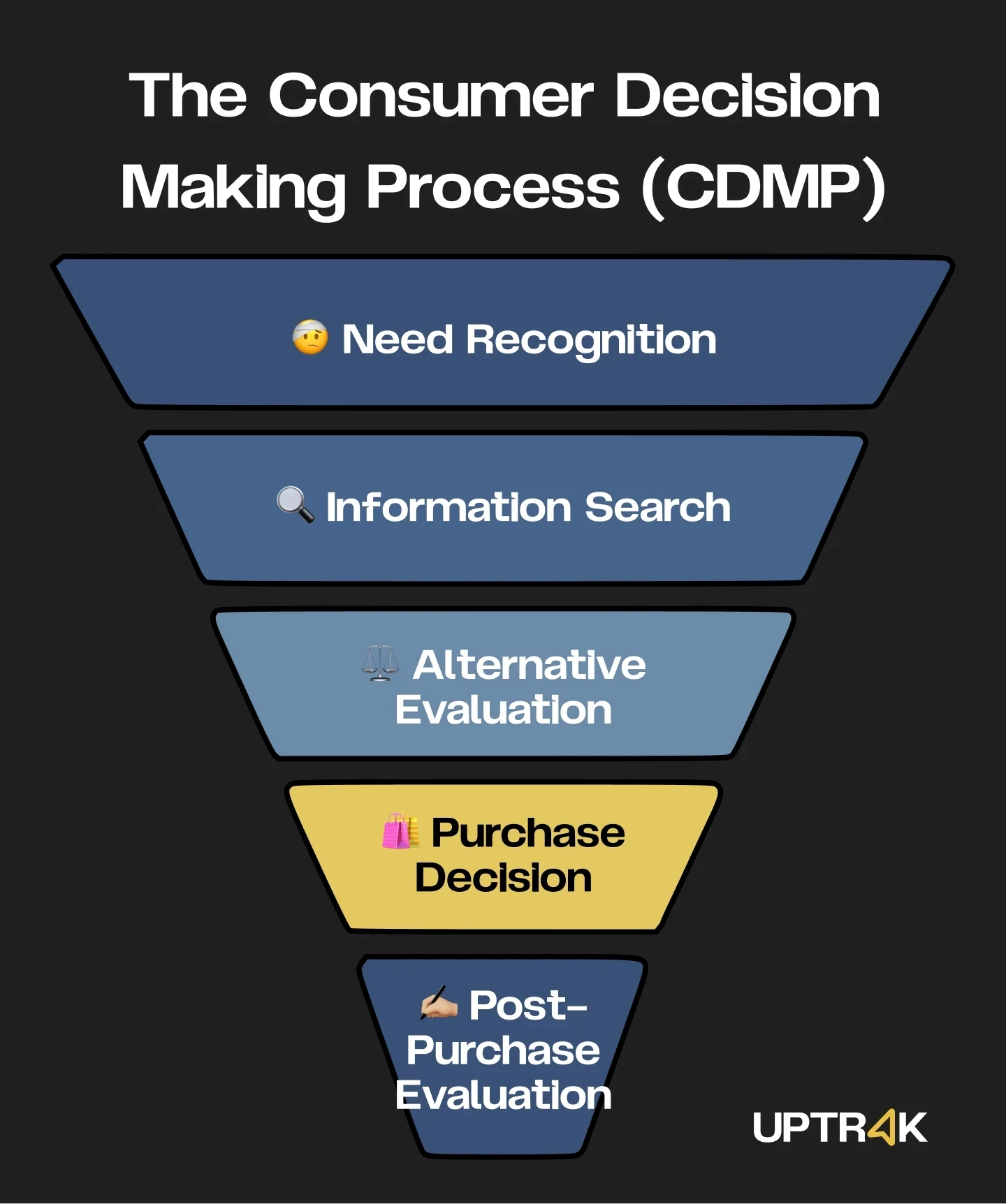
The CDMP In Practice: A Hypothetical
Let’s say you have a partner, and one of you is pregnant. You don’t know it yet, so there’s not really any reason to be looking up prams or nappies (even if Target is already trying to sell them to you.)

Need Recognition
After experiencing some morning nausea, a lightbulb goes off, so you run to the chemist for a pregnancy test, and you see the two lines. Exciting times for you. But also, it’s a very clear marker denoting your “point of market entry.” You’re now in the market for baby stuffs.
But do you immediately go out and buy a pram? No way.

Information Search
You start off looking up how to ensure your baby is born happy and healthy.
Maybe you go to Google or ChatGPT and ask ‘What things to buy to prepare for having a baby’ Maybe you even make a list.
You start talking to your friends and family who have had and raised babies. You start to feel a little bit overwhelmed with all the advice.
After a few months, you decide it’s time to get into pram admin mode. You Google prams realise they can be ludicrously expensive, so you start looking up ‘what makes a good pram’.
Maybe you find yourself on mother and baby forums you never knew existed and reading baby-related blog-posts.
Maybe you subscribe to a popular mother and baby newsletter and get served an issue centred entirely around the best prams to buy in 2025.
Alternative Evaluation
Okay so now you know roughly what brands you like, the bare minimum features you need, and the rough price-range you’re comfortable with. Now it’s time to more seriously evaluate your options.
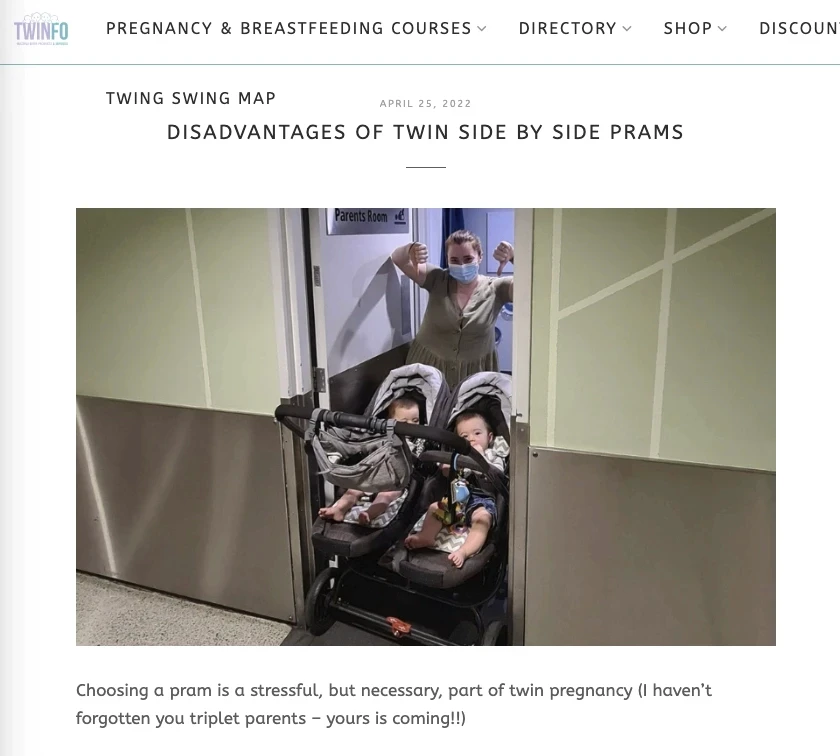
If you're expecting twins, maybe you find yourself googling ‘why tf do people buy those side-by-side double prams when they literally cannot fit through doors and they also take up the entire footpath’.
You start evaluating the different pram makers, and pram types, and evaluating which one will get you the most bang for your buck.
This means looking up direct comparison articles (pram A vs Pram B) or (Brand A vs Brand B), reading online reviews, maybe even asking other parents questions in online forums, or again, asking friends who’ve used similar prams in the past.

Purchase Decision
So it’s now a couple of months until the baby’s due, and you’re feeling like a pram expert. You know the specific pram you’re looking for.
Now in Google, you’re searching for much HIGHER INTENT keywords like
‘baby banter k780 swift stockist near me’ or maybe
‘Baby Kingdom Discount code’.
Maybe you organise a baby shower and create a wishing well on a registry.

Post Purchase Evaluation
Then who knows, you buy the pram, and it breaks after a few months, so you leave a negative online review and warn other parents not to buy it.
Practical Applications of the CDMP
(AKA How To Use the CDMP to Set Up Foundational Marketing Systems)
I know the above sounds incredibly basic, because it is. 100%. But that’s why it’s so damn useful.
Basic means you’ll remember it. And if you can remember it, you can use it for a BUNCH of different stuff.
Here are the real-life applications I use it for:
Planning ‘Lead Magnets’
A lead magnet is a free gift/resource/tool that gives your audience a lot of free value away upfront, solving an immediate pain-point they have, hence progressing them through the CDMP towards buying your service.
If they want your lead magnet, they have to trade their name and email for it, hence opting into your sales and marketing pipeline, meaning you can then NURTURE them into paying customers.
Lead Magnet Examples:
So, if you’re an IP lawyer, you might offer ‘The Essential IP Protection Checklist for Startups’
If you’re a crypto tax accountant, you might offer a ‘DeFi Tax Calculator’ template
If you’re a Logo Designer, you might offer ‘The Brand Personality Quiz’.

Welcome Sequences
A Welcome Sequence is a series of automated emails, which gets sent out over several days/weeks after someone enters your pipeline.
Each successive email is designed to ‘nurture’ the prospect through each subsequent node of the CDMP. For example:
The first email focuses around problem recognition. “If you’ve got this problem, my guess is that you’re likely experiencing these other problems too - right?”
However the last two emails in the sequence focus more around pressing the purchase decision, perhaps with discount incentives etc.
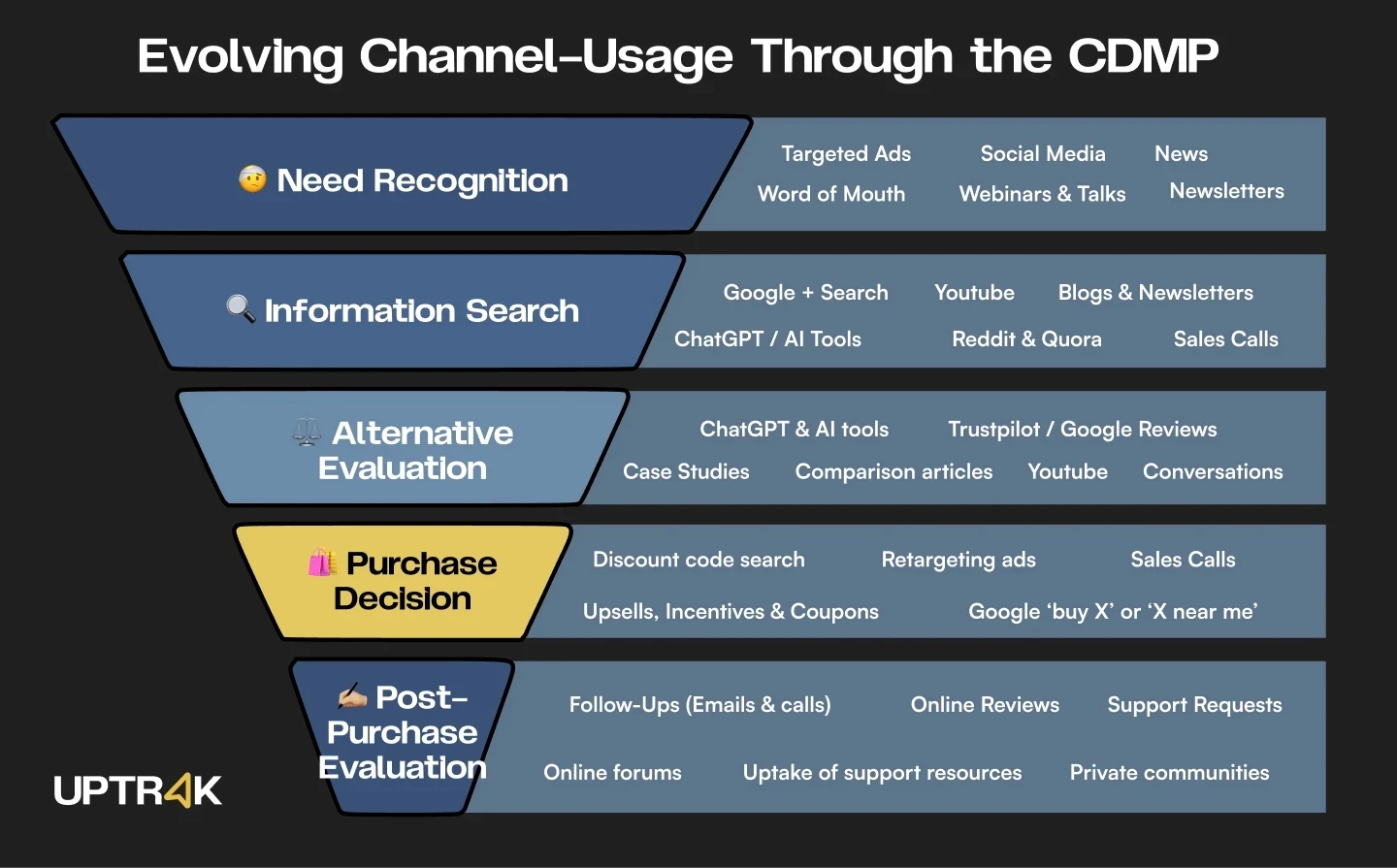
Finding New Channels to Reach Buyers
In the above examples of, we identified a bunch of channels we could look at, including:
mother and baby blogs
newsletters
Maybe you partner with a baby-shower registry platforms
Maybe you write an article on why inline double strollers are so much better than side-by-side double strollers.
Once you consider the CDMP, you realise there's a TONNE of extra low-hanging fruit where you can reach your audiences in the stages before they're ready to buy.
Sales Pages and Video Sales Letters (VSLs)
Quick crash course: key characteristics of a Sales Page:
It’s a very long page on your website which pitches one of your paid offers.
It shows ONE Call to action, which is the next step in the booking funnel (i.e. book a meeting, or fill in this form). This means NO links to ‘Our Team’, ‘About Us’, ‘Case Studies’, ‘Newsletter Signup’ etc.
In that sense, your sales pages are long, but deep (because they’re funnels).
VSLs often live on Sales pages to support the sales process.
The entire purpose of your sales pages/VSLs is to guide people through every stage of the CDMP - which is why they can often be quite long. By the end, your prospects should be better able to articulate the pain points they’re experiencing and the dream outcomes they’re chasing. More importantly though, they should see you as the clear and OBVIOUS path to getting there.
Using Intent to Maximise ROI for SEO, SEM and Paid ads
Google itself uses the CDMP. Why? To gauge audience INTENT (informational, navigational, transactional and commercial).
Someone searching “buy pram in Sydney” is holding their credit card. So if you need to get money into the business right now, paid ads served to those keywords makes sense.
Conversely, someone searching “different pram types” isn’t buying today - they’re just gathering info. However, assisting their research journey establishes you as a trustworthy, helpful authority - and this often pays dividends later on, when the prospect is making their buy-decision.

Final Thoughts
The real power of the CDMP is that it gives you an ultra-simple, mental model for visualising how your marketing and sales initiatives piece together. When it clicks, with little effort, you can:
identify opportunities to make your brand more omnipresent in the buyer journey
articulate the goals and functions of each marketing and sales initiative inside the broader machine that is your business.
Take one of the most common questions I get: “Why bother with email marketing?”
My answer is always the same:
Social platforms like Instagram are great for grabbing attention (top of the funnel), but they’re leaky buckets - you have to keep pouring effort in, and if the algorithm shifts, your reach can disappear at the critical point when your prospects are ready to pull the trigger.
Newsletters, on the other hand, nurture people in the middle of your funnel. That’s critical when your offer isn’t an impulse buy, because it gives you the opportunity to stay front-of-mind in the weeks, months, or even years it can take someone to decide.
Details
Date
Category
SEO
Reading
8 Min
Author

Alex Kelso
Digital strategist
Solo studio operator in Sydney, backed by a team of Claude agents and a network of creators and marketers.
Related News

